



While the process can be daunting, it is a worthwhile pursuit. By conducting thorough research and due diligence to find a suitable partner, you can reduce production costs and increase profits.
Preparing to Find the Best Manufacturer
Understand Your Manufacturing Needs
Before choosing a manufacturer, it is essential to have a clear understanding of your business’s product. There are different types of manufacturers in China, specializing in different kinds of production. Each one will have its own specifications that are required from a business before they will agree to work with you.
When searching for, and later approaching a manufacturer, a business needs to be able to communicate their product specifications, volume requirements, and budget. Understanding these factors will help narrow down the potential manufacturers that could be a good fit for your business.
Define Your Product Specifications
Clarity on product specifications is vital for accurate communication, reducing the risk of misunderstanding and errors. Physical specifications such as materials, dimensions, weight, and surface finish need to be known. Also, functional specifications like performance, durability, usability, and safety should be defined, so that they can be shared with potential manufacturers to see if they are capable of producing what is needed.
Once a partner has been chosen this understanding of the product’s specifications will help with quality control by defining acceptable quality standards and enabling manufacturers to adhere to specific requirements. This precise communication will ultimately help with cost control. It allows manufacturers to accurately estimate costs and avoid unexpected expenses.
Assess Your Volume and Budget
A manufacturer’s volume of production must be understood when exploring how to find a manufacturer in China. A business with high-volume production needs to find a manufacturer with large production capacities that can handle the orders efficiently. Likewise, a business with lower volume production needs to find a manufacturer that specialises in small-batch production.
Every Manufacturer has an MOQ (minimum order quantity). This number must be met in order for a manufacturer to agree to work with a business. A low-volume production must be aware of a manufacturer’s MOQ.
Budget is another factor in manufacturer selection. Like everything else, “you get what you pay for” applies to manufacturing. There are manufacturers with competitive pricing and cost-saving measures that can help companies stay within their budget. However, value-driven companies might opt for a manufacturer that provides higher quality or additional features that cost more to work with.
A business needs to understand its budget and what they are trying to accomplish to make sure they partner with the right manufacturer. This includes planning for scalability. By forecasting demand a company can choose a manufacturer with the capacity required to scale up or they decide to move to a new manufacturer as demand increases. This choice will depend on budget and cost management.
Researching Potential Manufacturers
Utilizing Online Platforms
The most accessible way to find a factory in China that can be used as a supplier is online. Online platforms can connect factories and suppliers in China to buyers.
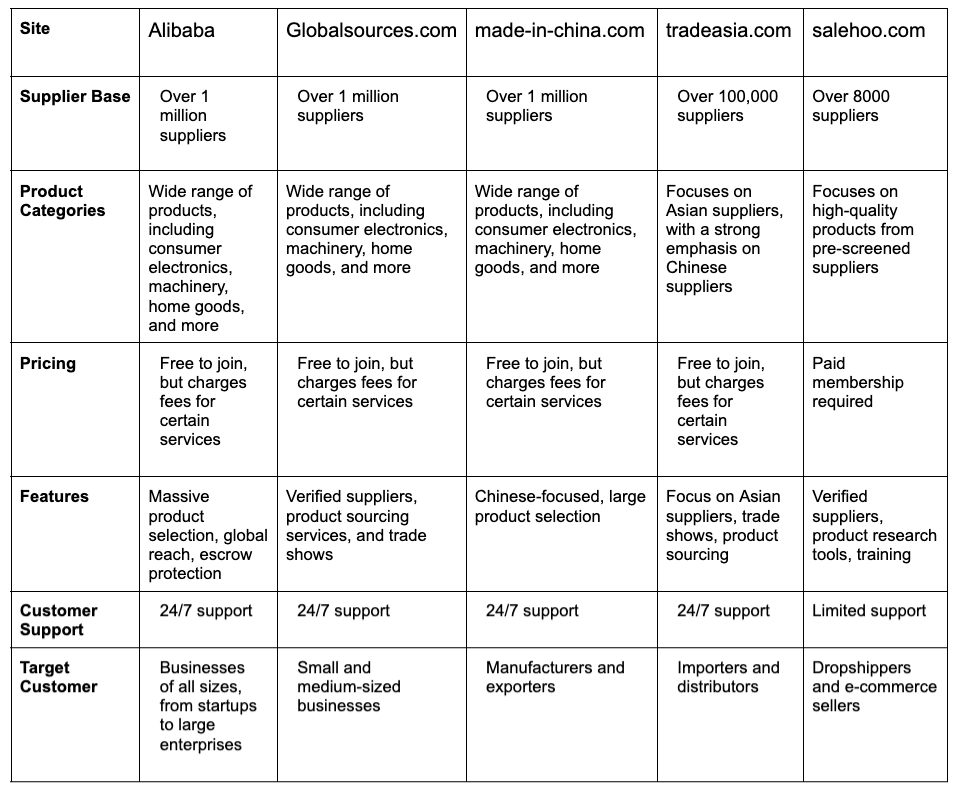
Five popular sites are:
Here’s a comparison of these sites based on six key metrics:
Attending Trade Fairs
Another method for finding a Chinese manufacturer and supplier is by attending trade shows. Trade shows are attended by suppliers that have spent money to be there with buyers where both parties can showcase their products and services. For this reason, a company can confidently talk to suppliers at trade shows knowing they are serious.
These gatherings also offer the opportunity to meet face-to-face to discuss the product together and get a feel for what manufacturer could be the best fit.
There will be samples from the suppliers that buyers can interact with and the buyer can also show potential manufacturers their prototypes. A trade fair is a good opportunity to get into the details of the business’s product and do in-depth research.
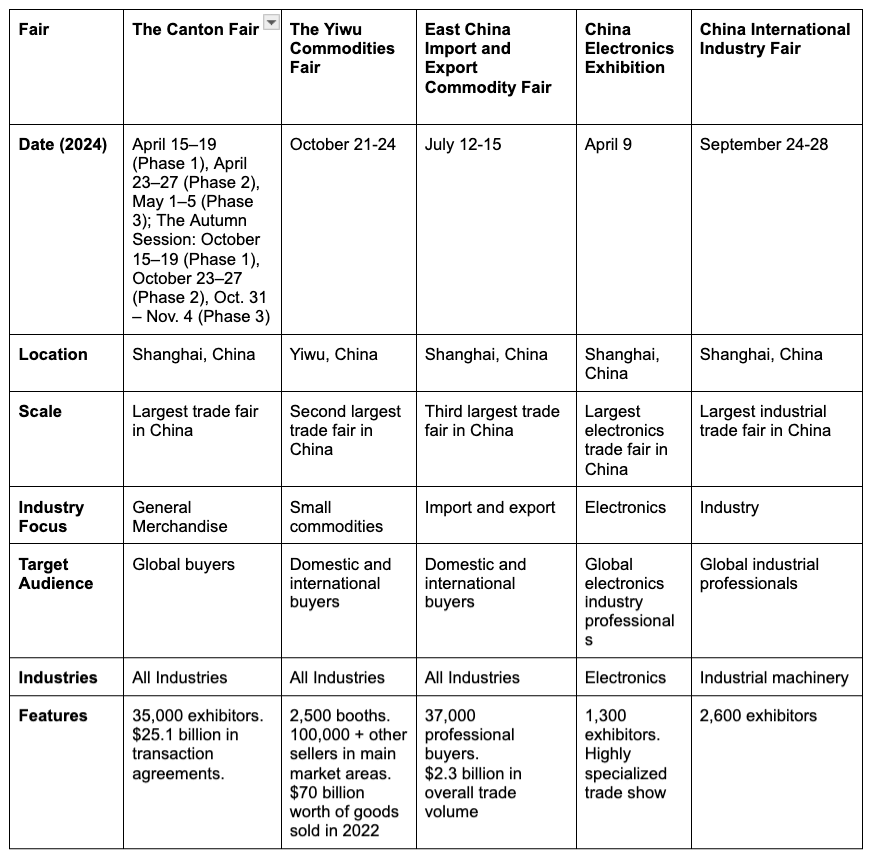
Some popular trade fairs are:
- The Canton Fair
- The Yiwu Commodities Fair
- East China Import and Export Commodity Fair
- China Electronics Exhibition
- China International Industry Fair
The below chart compares each fair according to seven key metrics:
Leveraging Professional Networks
Professional and social networks are another way for a business to find and research potential manufacturers. Sites like LinkedIn and Facebook can connect a company with other industry professionals.
LinkedIn allows users to search for manufacturers based on industry, location, size, and other criteria, making it easy to identify potential partners. It also hosts numerous industry-specific groups where manufacturers and buyers can connect and explore opportunities.
Likewise, Facebook will potentially have a relevant group where you can connect with others who are sharing their experiences and knowledge about how to find a manufacturer in China and how to find a supplier in China.
Evaluating Chinese Suppliers and Manufacturers
Researching and Comparing Manufacturers
When researching potential manufacturers, a company needs to know their requirements: production type, materials and components, design and development, certification, pricing and packaging, shipping, etc. This knowledge will define the search criteria needed for finding the best manufacturing fit.
Before choosing a partner it is important to select a few potential suppliers or manufacturers based on what the business’s needs are. From this shortlist, each manufacturer can be judged based on their capabilities, industry expertise, and specialisation in specific products or materials.
Verifying Manufacturer Credentials
Avoiding scams and manufacturers that are not capable of fulfilling what is required is important. Online reviews for one supplier might be glowing but they can’t be trusted. A company has to do its due diligence to make sure they are choosing a capable partner.
As mentioned above, trade shows help identify serious and reputable groups since they’ve paid to be there. Scammers are not going to pay real money for their grift.
But if attending a trade show is not possible and research is solely happening online there are various methods of ensuring the credentials of a manufacturer.
On sites like Alibaba.com where there are an endless amount of suppliers, it can be difficult to know if you’ve found a good one. One way to help in this situation is to use the filtering tools and look for buyers who have been on the platform for several years. These sites also give suppliers trust badges and show they’ve been verified and can be trusted.
This is also where connecting with other people through online groups is helpful. Corresponding with someone who has had experience with different vendors can be a source of a trusted review.
If possible, a factory visit is an excellent way to verify the facility, the equipment, and the team.
A valuable resource in helping with this is a third-party agency. Many companies specialise in knowing the many manufacturers and suppliers in China and they can help guide a business in finding the best partner. These companies not only have existing relationships with manufacturers but are also valuable for conducting factory and production inspections that ensure a manufacturer’s legitimacy.
Assessing Capabilities and Expertise
Beginning a dialogue with potential manufacturers is the first step in figuring out what factory has the capabilities and expertise that will best serve your company. A company should ask about:
1. Quality Control and Standards: This includes any certifications the manufacturer holds, quality management and inspection procedures, and their track record of meeting quality specifications.
2. Production Capacity and Capabilities: The factory management should be clear about its manufacturing equipment, technology, workforce size, and experience. It will help provide a picture of what they are capable of.
3. Material Sourcing and Supply Chain: It is important to know if the factory has reliable suppliers, stable material availability, and efficient inventory management.
A dialogue with the factory will help indicate what their expertise and experience is. A manufacturer’s experience is not just important for successful production but also in helping a company understand industry standards and regulations.
Asking for samples will help to evaluate what each factory is capable of and the quality of their work but the best way to assess the manufacturer’s capabilities is with a factory visit.
Ethical and Sustainable Manufacturing
Checking for ethical labour practices and sustainable manufacturing processes begins online. There are industry reports and reviews online that can indicate how a factory treats its workforce and what its environmental impact is.
Reviewing certifications and compliance can provide proof of a manufacturer’s commitment to ethics and sustainability. Certifications such as BSCI (Business Social Compliance Initiative) and SA8000 (Social Accountability International) indicate compliance with labor standards and ISO 14001 (Environmental Management System) or GOTS (Global Organic Textile Standard) indicate environmental compliance.
Again, here a factory visit can be useful for observing the working conditions firsthand.
Communication and Location Considerations
Most of what has been discussed in this article has been related to effective communication with a manufacturing partner. Communication is key in finding the best manufacturer for a particular product and in ensuring that production is successful.
Making sure both parties are on the same page is key to having a product produced and shipped without any difficulties. The needs of both the client and the factory have to be understood so there are no surprises that affect the quality of the product or the schedule. This can be difficult sometimes because of the language barrier.
To address this, it is helpful to:
- Make emails simple and concise: An email should only be about one topic that isn’t too long and uses short sentences.
- Use visuals when possible: Pictures can be more effective in communicating what needs to be made to the product.
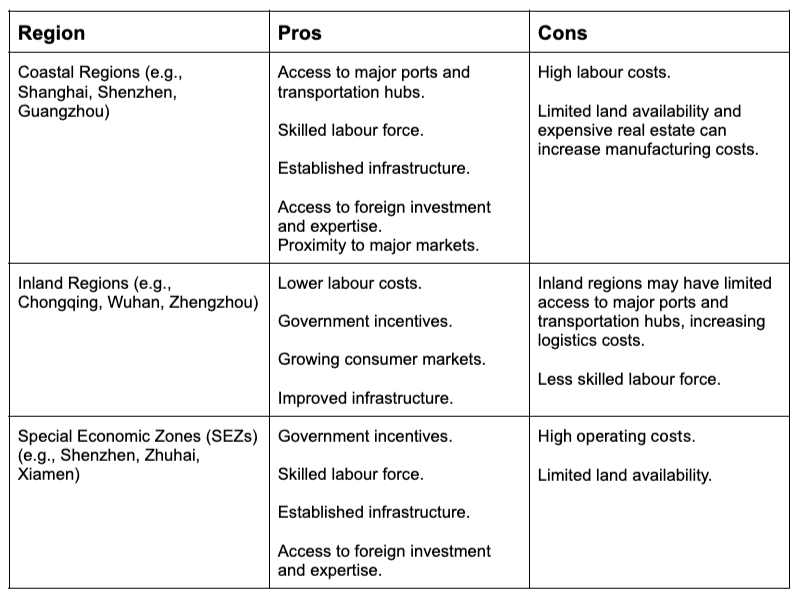
China is a large country with different regions of production. Each region has its benefits and drawbacks.
The Role of Sourcing Agents
A sourcing agent is an individual or company that acts as an intermediary between buyers and suppliers that can help buyers find a manufacturer and communicate with them.
Doing business in the global marketplace can be daunting and navigating all of its challenges might be too much for a business. This is when a sourcing agent can be useful. They have specialised knowledge and can help identify quality suppliers, manage relationships, provide quality control, and negotiate contracts. Although there is a cost to using a sourcing agent, partnering with one can end up being a cost savings by saving time, improving quality, and helping with risk mitigation.
Negotiating and Finalizing Agreements
Negotiation Strategies
Part of understanding how to find a manufacturer or supplier in China is using the shortlist of possible partners in the negotiation process. Asking for quotes from multiple manufacturers or suppliers will help in understanding the market’s average price. When negotiating, points to remember are price and payment terms, quality and specifications, delivery and logistics, MOQs, and production capacity and lead times.
Finalizing the Agreement
Some essential elements of a manufacturing agreement in China to remember are:
Quantity, delivery timeline, and price and payment.
Intellectual property is also important. Clear ownership of the rights of designs and patents needs to be featured in a contract with confidentiality and non-disclosure provisions.
Quality Control and Logistics
Ensuring Product Quality
It is important to define specific quality requirements for the product to ensure quality control. Sampling should be provided so adjustments can be before final approval of production.
Factory audits are also a useful tool in ensuring quality standards.
Managing Shipping and Logistics
Manufacturing requires dealing with a variety of logistics. Shipping is a significant consideration when production happens in China. Shipping options of ocean freight or air must be looked at while considering shipment size and weight, transit time, and budget. Consolidating shipments, when possible, can help lower shipping costs.
Customs is another factor that requires consideration. The destination country of the product will have import duties and taxes. As well, customs clearance can impact delivery time. This process involves documentation so it is important to have it all in place before shipping.
A third-party sourcing agent can help these processes go smoothly and make them more cost-efficient.
Conclusion
Manufacturing in China offers many benefits that can lead to more profits for a company but there are obstacles to finding a successful partner. A company must have a clear picture of what they want produced so they know what they are looking for when searching for a manufacturer.
Extensive research must be conducted to find the right fit and avoid scams or unserious suppliers. This process will verify manufacturers with the right expertise and facility to successfully create the desired product.
Using a third-party sourcing agent is a helpful tool but it does remove the need for a methodical process. Due diligence and clear communication will offer the best results in establishing a manufacturing partnership.