



Key Takeaways:
Paying for overseas freelance work comes with challenges and there is a variety of things to consider to make sure your business and the freelancer are getting the most from the arrangement:
- The fluctuation of currency exchange rates and the different rates that are offered by payment platforms and banks.
- Transaction fees that come with sending money internationally.
- Speed of transactions
- Ensuring compliance with international tax laws and regulations.
- Effective communication with freelancers
- Choosing the right platform that is cost-effective and can safely transfer funds.
Understanding the Basics of International Payments
When using freelance workers overseas, some key factors affect international payments and can impact the transaction.
Factors to consider are:
1. Currency Exchange Rates: The fluctuations of exchange rates can affect the cost of the payment and the freelancer’s earnings as well as the value of the currency the business is holding.
2. Transaction Fees: There are a variety of payment methods a business can use to transfer funds to freelance workers. However, none of them are free. Payment platforms and banks charge fees for international transfers. It is important for a business to discuss these fees with their freelancers before work begins so there is an understanding of who is paying the fees and how they will impact payment.
Different payment methods also have varying processing times and security measures. Businesses need to compare fees and these other factors to find the most cost-effective option that also provides speed and reliability.
3. Local Tax Laws: Tax laws in the recipient’s country may impose withholding taxes or other charges on incoming payments. Businesses need to be aware of these laws to ensure compliance and avoid penalties.
It is important to know the legal obligations that come with international payment regulations. Compliance with these laws is necessary to avoid additional costs that can stem from fines, penalties, and legal fees.
Challenges and Solutions in Paying Freelancers Overseas
Navigating High Transaction Fees and Slow Processing Times
When considering how to pay freelancers overseas, choosing the right payment method is crucial to minimizing transaction fees and speeding up payment processing. The right payment platform will offer competitive exchange rates and low transaction fees, while also processing the transaction quickly.
The fastest platform will use local payment networks which are faster than cross-border transactions. When local networks aren’t available, access to multiple payment networks is necessary so the most efficient network can used for the transaction.
Compliance with International Tax Laws
Understanding the laws in both your business’s jurisdiction and the freelancer’s is vital to ensure legal compliance. The right payment platform can help a business with compliance by automatically withholding taxes based on the freelancer’s location and tax status. Tax reports and documentation that businesses can use to file with tax authorities can be generated by some platforms to help ensure compliance with both domestic and international tax laws.
Engaging with tax professionals is another key to ensuring compliance. By consulting with an accountant or tax lawyer a business can stay informed of tax laws and regulations.
Effective Communication with Freelancers
Clear communication between the business and the freelancer is important in preventing payment issues and disputes. The nature of sending money internationally means dealing with fees from the bank or payment platform as well as fluctuating currency rates. These things will affect the payment the freelancer receives. Early and clear communication about these costs will prepare the freelancer for the effect on their pay. Both parties having an understanding will help prevent disputes.
Currencies and Conversion Rates
When looking into how to pay freelancers overseas, navigating changing exchange rates and sending money in different currencies is a significant consideration. Payment platforms can handle currency conversion but it comes with processing fees and they can have unfavorable exchange rates.
The fees applied to currency conversion and the exchange rate offered on each platform need to be closely examined to ensure your business is paying freelance workers most cost-effectively.
Popular Payment Methods for Overseas Freelancers
Bank Transfers
A common way to send money internationally is to wire the payment through a bank transfer. This method is secure and it can be used with relative ease knowing the sent funds are safe. However, bank transfers can be expensive with fees from $25-$50 per transfer. Currency conversion can also have fees for the sender and sometimes the recipient as well. These transfers also take time and are not the most prompt way to send a payment.
A bank transfer would be most appropriate for large transactions where the fee is not relatively significant. These transfers are also commonly used to transfer funds for real estate purchases or investments in foreign countries.
Online Payment Platforms
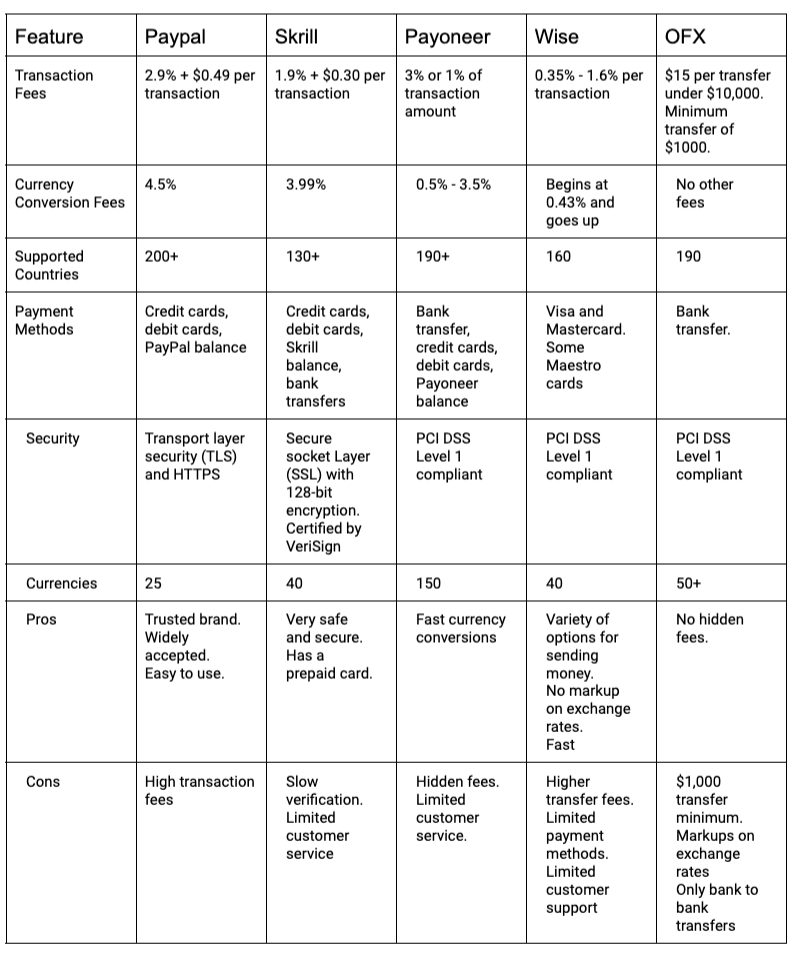
These platforms are a popular and convenient way to send money internationally and convert currencies. There are several, Paypal being the most well-known, but here is a comparison of five:
EMI / Multi-Currency Accounts
The global market has demanded that businesses deal with multiple currencies. A consequence of this is that companies have to deal with changing exchanges and fees associated with conversion. Multi-currency accounts like Payset have been created as a more efficient and cost-effective way of dealing with multiple currencies.
EMIs provide the ability for a business to receive and hold funds in multiple currencies that will not be affected by exchange rate fluctuations and offer a convenient and cost-effective way to make payments to freelance workers in other countries. They allow businesses to pay in their preferred currency, reducing conversion fees. If a conversion is needed these accounts can automatically convert at competitive rates and the transaction fees charged are often lower than banks
As well, EMIs use secure payment platforms to ensure the safety and speed of transactions.
Freelancer Platforms
Platforms like Upwork, Fiverr, and others have become popular ways for businesses and freelancers to connect. They are an intermediary between the parties and facilitate payment at agreed-upon times or milestones. Upwork uses an escrow system, holding the funds and releasing them once the client approves the work. Fiverr manages a wallet for each user where funds are stored until they are withdrawn.
These companies use multiple payment gateways including Paypal. It is convenient but it means there are multiple layers of fees. The payment method will have fees and the freelancer platform will also have service fees and processing fees that need to be considered when negotiating a contract.
Cryptocurrency Payments
Cryptocurrency as a payment method is becoming more common for international freelance workers. It has benefits, including lower fees, faster processing times, borderless transactions, and enhanced security and privacy.
There are challenges with this method as well. The prices of crypto can be volatile, which can introduce uncertainty into payment amounts. There is a lack of regulation in the market, which can create legal and compliance challenges for businesses using it as a payment method. The tax implications of cryptocurrency in different jurisdictions can be more murky than traditional currencies making compliance more difficult. Finally, the newness of crypto means its adoption is not yet widespread so it is often not an available payment method on platforms.
Best Practices for Paying Freelancers Overseas
- Clear communication with freelancers is important to making sure payment expectations are reasonable. The added fees that come with international payments add an expense that needs to be understood when agreeing on payment terms for a project. This should be done early before any work is done to avoid any possible disputes.
- Exchange rates differ depending on the platform being used. Make sure you find one that offers competitive rates. Fluctuating rates can impact the value of the currency in your account. An EMI provides stabilization to the currency that is being used to pay a freelancer.
- Know the tax laws and regulations for international payments in your location to ensure compliance. Make sure you are getting the necessary documentation to file with tax authorities.
- There are risks to overseas money transfers. Using a platform that might have better deals but lacks the proper security features can result in fraud, identity theft, data breaches, and loss of funds. To avoid this it is paramount to use a platform with the proper security features and certifications.
Conclusion
Using freelance workers in other countries can be a cost-effective way to find on-demand expert help for your business but it comes with challenges that need to be navigated.
Paying freelancers overseas requires careful consideration of payment methods, regulations, and communication. By understanding the challenges and adopting best practices, businesses can be compliant with regulations around international payments and make using freelancers cost-effective.
The most important consideration in paying freelancers overseas is the platform used to transfer funds, as fees and exchange rates can be impactful. Opening an account with Payset is an excellent cost-effective option to securely provide payment to freelancers.
How Payset Can Help
The Payset multi-currency account supports up to 34 currencies as well as currency exchange between 38 currency pairs. Sending and receiving funds in the local currency means there are no exchange fees. Because Payset uses local payment networks wherever possible, payments can be issued much more quickly and affordably in comparison to other cross-border transactions.
In addition, if both the sender and recipient have Payset accounts, all transactions are free and instant.
In short, a Payset account will save your business money while ensuring the freelancers you employ are paid promptly and in the currency of their choosing.