



Key Takeaways
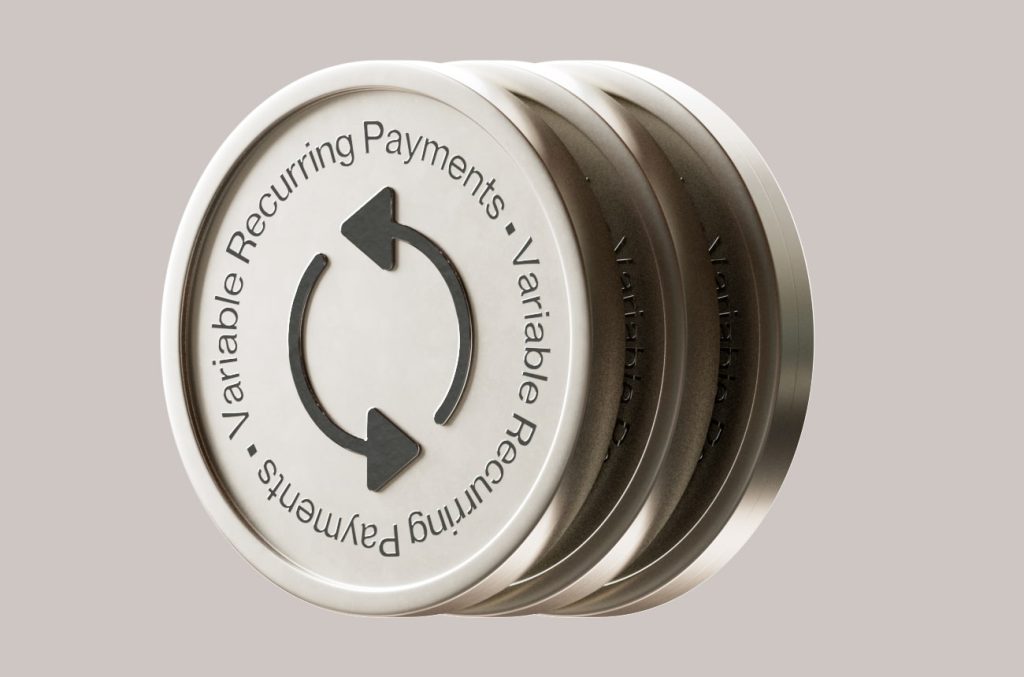
- Variable recurring payments (VRPs) are pre-authorized, automated payments that allow customers to set maximum transaction amounts and other limits
- As a type of open banking, VRPs provide greater flexibility and advantages than other automated payment options such as direct debit
- The UK is leading VRP efforts, and Europe is expected to learn from its approach
Variable Recurring Payments in Europe and the UK?
Europe and the UK are increasingly exploring variable recurring payments (VRPs).
VRPs are pre-authorized payments that allow an account holder to arrange transactions of varying sizes by setting maximum amount limits and transaction frequencies.
Compared to alternatives, such as direct debit, variable recurring payments are easy to modify and cancel.
VRPs can also provide instant settlement, lower fees and transaction costs, better security and transparency, and other improvements over their traditional counterparts.
VRPs are considered a type of open banking, which allows third parties to take part in banking activities with customer permission. Specifically, VRPs involve Payment Initiation Service Providers (PISPs), or services that perform the necessary transactions on behalf of users.
Payment Industry Excited About VRPs
A recent report from Finextra cites several payment industry members who believe VRP technology will grow in Europe and the UK in the near future.
Andrew Boyajian, an executive at the open banking platform Tink, said that he expects VRPs to achieve their full potential in the coming years.
Boyajian said that existing commercial payments are “clunky and awkward,” whereas VRP payments are transformational and give businesses a competitive advantage.
Francesco Simoneschi, CEO of the open banking platform TrueLayer, asserted that VRPs are “poised to revolutionise” financial services. He said banks are offering VRP features competitively, noting that TrueLayer is working with NatWest and others to offer the feature.
Boyajian said VRPs can be used for payments such as streaming subscriptions and utility bills, while Simoneschi described applications in grocery subscriptions and charity donations.
Europe Expected to Follow UK
Finextra said that European regulators are building an open finance architecture but acknowledged that the UK is ahead of Europe’s progress on VRPs.
Europe can learn from the UK to ensure a “smooth transition,” it said.
In the UK, the Competition and Markets Authority (CMA) has already mandated the implementation of VRPs at nine major banks. Additionally, the UK’s Payment Systems Regulator (PSR) has begun a consultation to expand VRPs across the country.
Simoneschi commented on the latter effort. He said that the UK’s PSR should provide incentives that help banks monetize VRP and encourage them to go beyond minimum regulatory requirements. Doing so will create a system that “works for all parties,” he said.
Finextra also distinguished two types of variable recurring payments: commercial VRPs and sweeping VRPs. The former involves payments between customers and businesses, while the latter allows account holders to automatically move funds between their own accounts.
Sweeping VRPs are currently available in the UK but not Europe.