




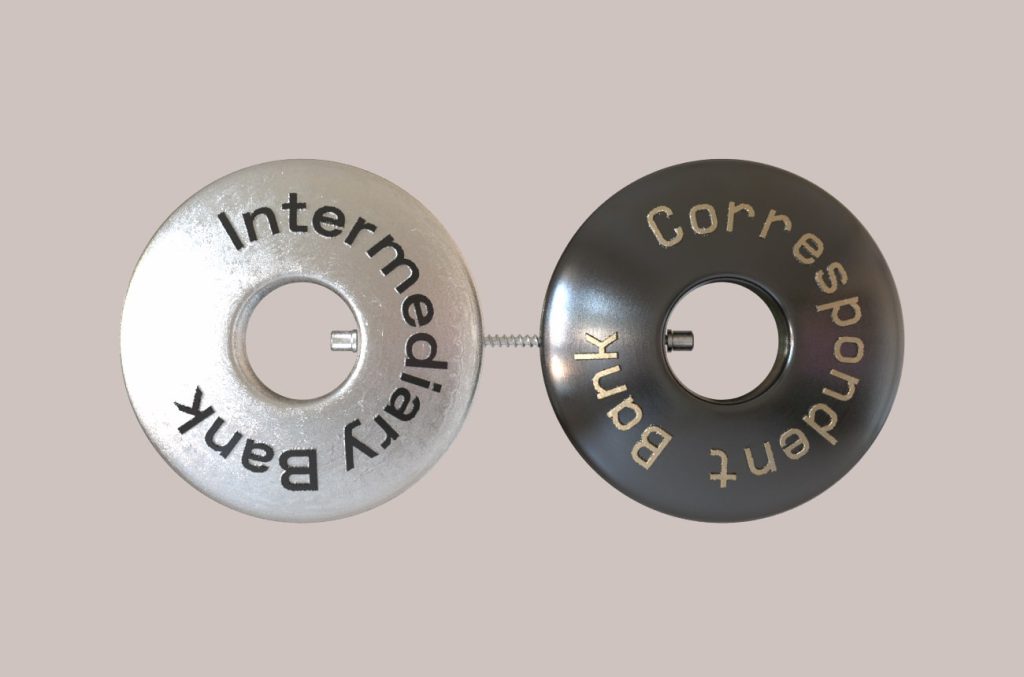
Modern global finance requires that banks transact and communicate with partners all around the world. As a result, financial institutions often rely upon correspondent banks and intermediary bank accounts in order to carry out interbank transactions.
The differences between correspondent banks and intermediary banks is broad, but these two types of banks are mainly distinguished by the number of currencies that they handle. Correspondent banks typically work with many currencies, whereas intermediary banks usually handle just one local or domestic currency.
Here’s how correspondent banks and intermediary banks can be distinguished.
What Is a Correspondent Bank?
A correspondent bank is a financial institution that provides its services to another bank—especially a bank in a foreign country.
Correspondent banks offer intermediary services or act as a middleman. They handle various activities including wire transfers, business transactions, monetary settlements, check clearing, currency exchange, and deposits. They also collect documents for other banks that they are in contact with and otherwise manage communication.
Domestic banks rely on correspondent banks in order to handle transactions moving to and from other countries. This means that domestic banks can serve users internationally without any need to operate bank branches in foreign countries, and without the need to build an extensive relationship with a foreign bank. Often, banks will locate a suitable correspondent bank by searching the SWIFT network.
Correspondent banks may refer to accounts with two similar terms: nostro and vostro. Nostro accounts—from the Latin word for “ours”—are accounts held by a foreign bank on behalf of a domestic bank. By contrast, vostro accounts—from the Latin word for “yours”—are accounts held by a domestic bank on behalf of a foreign bank.
Both terms (nostro and vostro) refer to a single account; they simply describe the perspective from which one bank looks at the other.
This system allows banks to track debits and credits or assets and liabilities, regardless of which side of the banking relationship they are on.
What Is an Intermediary Bank?
Intermediary banks also provide intermediary services.
Intermediary banks are especially useful if two partner banks do not have an account with one another, or when one of the banks is not on the SWIFT network. In this case, the intermediary bank can help a transaction move from one bank to the other.
There is a key difference that separates intermediary banks from their correspondent bank counterpart. Intermediary banks typically only complete transactions involving a single currency, whereas correspondent banks usually handle multiple currencies.
Intermediary banks generally operate from the country whose local currency they handle. However, there are exceptions to this rule, and Intermediary banks may operate internationally, just like correspondent banks. Additionally, transactions may move through multiple intermediary banks in some cases.
As such, the two types of banks are not always clearly delineated.
Are There Fees Associated With Intermediary Banking?
As with most types of financial activity, intermediary banking carries fees.
Intermediary banks do not have standard costs, but fees typically range between $15 and $30 per transaction. These fees are among the banking industry’s highest rates, and fees are not always clear in advance, which can be an issue for some participants.
Exact fees depend on which role a particular bank pays in a transaction. Fees are typically paid using a standard SWIFT form, which uses three codes to indicate how fees will be paid: Originator (OUR), Beneficiary (BEN), and Shared (SHA).
OUR means that the sending bank pays all fees involved in a transaction, while the beneficiary bank receives the transacted amount at no charge.
BEN means that the receiving bank pays all fees. In this case, fees can be charged by the sending bank, not just the intermediary bank itself.
SHA means that the originating bank and receiving bank divide the relevant fees. For example, the sending bank may charge a sender fee, while the beneficiary may pay intermediary fees. Other charges may also be attached.
Currency conversion fees may be charged as well, if one side of the transaction expects to receive a currency that is different from the currency that is sent.
Usually, only financial institutions and certain companies interact directly with intermediary banks. However, intermediary banking fees may be passed on to end users, retail clients, and general banking customers
Bank customers may pay those fees directly, in the form of transaction fees, or indirectly, in the form of regular account fees.
How Can Payset Help?
Payset offers international payment services that can replace or eliminate the need for intermediary banks. By using a Payset multi-currency account to carry out your international transactions, you’ll be able to take advantage of the following features.
Low Fees
As a customer of Payset, you’ll receive fees tailored to your situation.
At Payset, our fees for Europe-wide SEPA transactions begin at just 0.4%, while our fees for international SWIFT transactions begin at .45%. Plus, when you send money to another Payset account or receive money from any source, you’ll pay no fees at all.
Even when you do pay a fee, you’ll avoid intermediary fees altogether, as you will not need to worry about the OUR, BEN, and SHA fee systems.
Multiple Networks
With Payset, you can send funds over multiple global banking networks including SWIFT, SEPA, ACH, Faster Payments, and CHAPS. You’ll also have access to an online banking account with an international IBAN number and a versatile payment card.
These features allow you to spend money wherever and whenever you need to, all around the world. Payset is ideal for travellers and international business users alike.
Multiple Currencies
At Payset, we offer support for multiple currencies. You can hold up to 34 currencies at once and transact in 180 different countries. Most currencies can be held for free; some account fees and currency holding fees may apply.
Click below to find out more or to sign up for an account.